100% Guarantee 642-885 Bootcamp 2021
We provide real 642-885 exam questions and answers braindumps in two formats. Download PDF & Practice Tests. Pass Cisco 642-885 Exam quickly & easily. The 642-885 PDF type is available for reading and printing. You can print more and practice many times. With the help of our Cisco 642-885 dumps pdf and vce product and material, you can easily pass the 642-885 exam.
NEW QUESTION 1
When implementing interdomain multicast routing, which mechanism can be used to advertise multicast sources in one domain to the other domains, allowing the RPs to build interdomain multicast distribution trees?
- A. Multiprotocol BGP
- B. PIM
- C. MSDP
- D. Auto RP
- E. BSR
- F. MLD
Answer: C
Explanation:
Multicast Source Discovery Protocol
Multicast Source Discovery Protocol (MSDP) is a mechanism to connect multiple PIM sparse-mode domains.
MSDP allows multicast sources for a group to be known to all rendezvous point(s) (RPs) in different domains.
Each PIM-SM domain uses its own RPs and need not depend on RPs in other domains. An RP in a PIM-SM domain has MSDP peering relationships with MSDP-enabled routers in other domains.
Each peering relationship occurs over a TCP connection, which is maintained by the underlying routing system.
MSDP speakers exchange messages called Source Active (SA) messages. When an RP learns about a local active source, typically through a PIM register message, the MSDP process encapsulates the register in an SA message and forwards the information to its peers. The message contains the source and group information for the multicast flow, as well as any encapsulated data. If a neighboring RP has local joiners for the multicast group, the RP installs the S, G route, forwards the encapsulated data contained in the SA
message, and sends PIM joins back towards the source. This process describes how a multicast path can be built between domains.
NEW QUESTION 2
Which two specific characteristics categorize traceroute in an IPv6 routing environment? (Choose two.)
- A. Traceroute can show the path to reach any destination IPv6 address.
- B. Traceroute returns an error for a link-local IPv6 address.
- C. Traceroute is based on ICMPv6 Type 1 (Destination Unreachable) reply packets to determine the network path.
- D. Traceroute is based on ICMPv6 Type 3 (Time Exceeded) reply packets to determine the network path.
- E. Traceroute is based on ICMPv6 Type 2 (Packet Too Big) reply packets to determine the network path.
- F. Traceroute for IPv6 implements a backwards compatibility option to provide a detailed report in environments running dual-stack.
Answer: AD
NEW QUESTION 3
Which technology is categorized as multicast ASM and multicast SSM?
- A. IP telephony
- B. video conferencing
- C. IPTV
- D. live streaming
Answer: D
NEW QUESTION 4
To which three IP multicast groups can a multicast MAC address "01-00-5E-4D-62-B1" listen? (Choose three.)
- A. 231.205.98.177
- B. 231.205.99.177
- C. 239.77.98.177
- D. 239.205.99.177
- E. 224.205.98.177
- F. 224.205.99.177
Answer: ACE
NEW QUESTION 5
Whichtwo attributes does BGP select before MED? (Choose two.)
- A. local preference
- B. weight
- C. lowest router ID
- D. lowest neighbor IP
- E. oldest route
Answer: AB
NEW QUESTION 6
Refer to the exhibit.
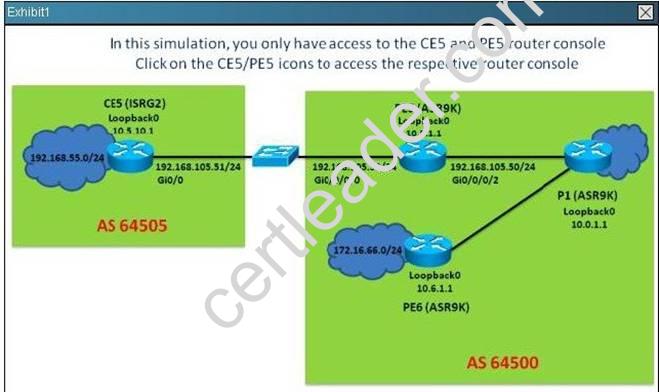
Which three statements regarding the BGP operations are correct? (Choose three)
- A. PE5 will set the local preferences 200 on all the prefixes sent to CE5
- B. PE5 will set the local preference to 200 on all the prefixes learned from CE5
- C. CE5 has received 5 prefixes from the PE5 EBGP peer
- D. CE5 has the BGP scan interval set to 30 seconds
- E. CE5 is announcing the 192.168.55.0/24 prefix via EBGP to the PE5 EBGP peer
- F. The AS-Path to reach the 209.165.202.128/27 prefix from CE5 is: 64500 64497 64498
Answer: CEF
Explanation:
#sh ip bgp | be Network
#sh ip bgp
#show ip bgp neighbors
NEW QUESTION 7
When configuring BFD, the multiplier configuration option is used to determine which value?
- A. The retry interval
- B. The number of BFD packets that can be lost before the BFD peer is declared "down"
- C. The minimum interval between packets accepted from the BFD peers
- D. The number of BFD echo packets that will be originated by the router
- E. The number of routing protocols that will use BFD for fast peer failure detection
Answer: B
NEW QUESTION 8
An engineer is enabling multicast routing across an entire core infrastructure. Which two
commands enable multicast routing on Cisco IOS XE instances? (Choose two.)
- A. ip multicast-routing
- B. ip multicast-routing vrf global
- C. interface type slot/path_id ip pim sparse-mode
- D. interface type slot/path_id ip cgmp
- E. interface type slot/path_id ip pim dense-mode
- F. ip mroute-cache
Answer: AC
NEW QUESTION 9
The 224.192.16.1 multicast IP address maps to which multicast MAC address?
- A. 01-00-5E-C0-10-01
- B. 01-00-5E-40-10-01
- C. 01-00-5E-00-10-01
- D. 01-00-5E-C0-16-01
Answer: B
Explanation:
Least significant 23 bits of IP address and pre-pend 01-00-5E
224 ignore
192 less 128 becomes 64 = 40
16 = 10
1 = 01
01-00-5E-40-10-01
NEW QUESTION 10
You noticed a recent change to the BGP configuration on a PE router, the bgp scan time has been changed from the default value to 30s. Which three effects will this change have? (Choose three.)
- A. The BGP table will be examined and verified more frequently
- B. The BGP keepalive messages will be sent to the BGP peers at a faster rate
- C. The BGP table will be modified more quickly in the event that a next-hop address becomes unreachable
- D. The CPU load of the router will increase
- E. The minimum time interval between sending EBGP and IBGP routing updates will decrease
- F. The BGP convergence time will increase
Answer: ACD
NEW QUESTION 11
Refer to the configuration exhibit, taken from a Cisco IOS-XR router.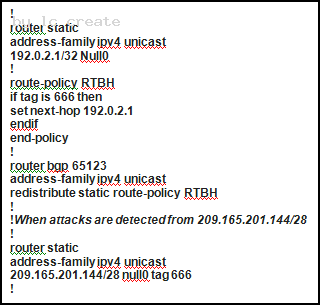
Which configuration change is required to properly enable this router as the signaling router for implementing source-based RTBH filtering?
- A. Set community (no-export) in the route policy
- B. Pass in the route policy
- C. Set local-preference 1000 in the route policy
- D. The 192.0.2.1/32 static route should be tagged as 666 (tag 666)
Answer: A
NEW QUESTION 12
Which multicast routing protocol is used to forward multicast data along the optimal path from source to receivers?
- A. PIM DM
- B. PIM Bi-Dir
- C. PIM SM
- D. SSM
- E. IGMP
- F. MSDP
Answer: C
NEW QUESTION 13
DRAG DROP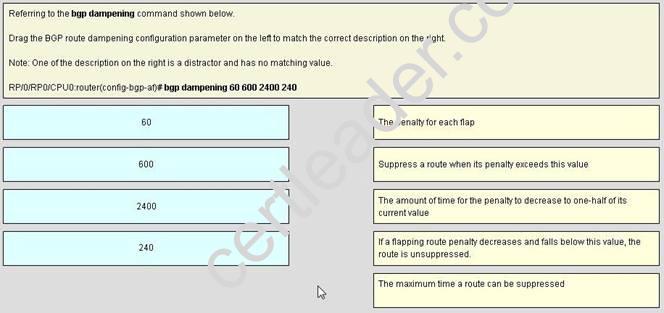
- A. Mastered
- B. Not Mastered
Answer: A
Explanation:
The amount of time for the penalty to decrease to one-half of its current value - 60 Suppress a route when its penalty exceeds this value - 2400
If a flapping route penalty decreases and falls below this value , the route is unsuppressed
- 600
The maximum time a route can be suppressed – 240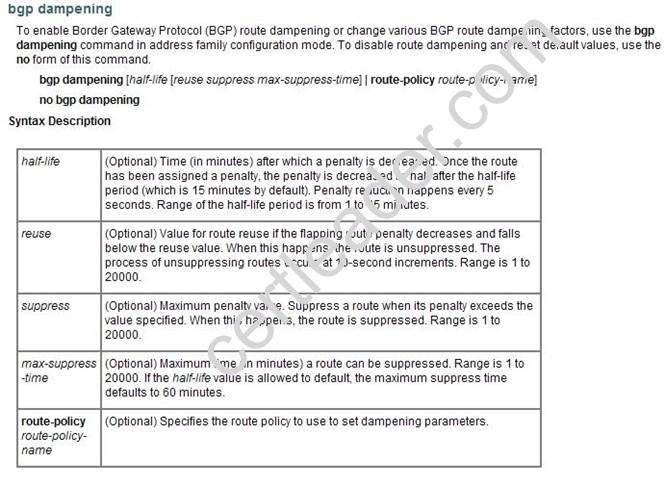
SO bgp dampening 60 600 2400 240 is:
60 half life
600 reuse
2400 suppress
240 max-suppress-time
NEW QUESTION 14
An SP core is running PIM on the network. Multicast groups in this networkare in the 232.0.0.0/8 range. Which commandenables multicast routing operations without using an RP?
- A. ip pim autorp
- B. ip pim ssm default
- C. ip pim bidir-enable
- D. ip pim register-source
Answer: B
NEW QUESTION 15
In Cisco IOS-XR, the ttl-security command is configured under which configuration mode?
- A. RP/0/RSP0/CPU0:P2(config)#
- B. RP/0/RSP0/CPU0:P2(config-bgp)#
- C. RP/0/RSP0/CPU0:P2(config-bgp-nbr)#
- D. RP/0/RSP0/CPU0:P2(config-bgp-af)#
- E. RP/0/RSP0/CPU0:P2(config-bgp-nbr-af)#
Answer: C
Explanation:
http://packetlife.net/blog/2009/nov/23/understanding-bgp-ttl-security/
NEW QUESTION 16
Which three statements regarding NAT64 operations are correct? (Choose three.)
- A. With stateful NAT64, many IPv6 address can be translated into one IPv4 address, thus IPv4 address conservation is achieved
- B. Stateful NAT64 requires the use of static translation slots so IPv6 hosts and initiate connections to IPv4 hosts.
- C. With stateless NAT64, the source and destination IPv4 addresses are embedded in the IPv6 addresses
- D. NAT64 works in conjunction with DNS64
- E. Both the stateful and stateless NAT64 methods will conserve IPv4 address usage
Answer: ACD
Explanation:
Stateful NAT64-Network Address and Protocol Translation from IPv6 Clients to IPv4 Servers
Stateful NAT64 multiplexes many IPv6 devices into a single IPv4 address. It can be assumed that this technology will be used mainly where IPv6-only networks and clients (ie. Mobile handsets, IPv6 only wireless, etc...) need access to the IPv4 internet and its services.
The big difference with stateful NAT64 is the elimination of the algorithmic binding between the IPv6 address and the IPv4 address. In exchange, state is created in the NAT64 device for every flow. Additionally, NAT64 only supports IPv6-initiated flows. Unlike stateless NAT64, stateful NAT64 does `not' consume a single IPv4 address for each IPv6 device that wants to communicate to the IPv4 Internet. More practically this means that many IPv6- only users consume only single IPv4 address in similar manner as IPv4-to-IPv4 network address and port translation works. This works very well if the connectivity request is initiated from the IPv6 towards the IPv4 Internet. If an IPv4-only device wants to speak to an IPv6-only server for example, manual configuration of the translation slot will be required, making this mechanism less attractive to provide IPv6 services towards the IPv4 Internet. DNS64 is usually also necessary with a stateful NAT64, and works the same with both stateless and stateful NAT64
Stateless NAT64-Stateless translation between IPv4 and IPv6 RFC6145 (IP/ICMP Translation Algorithm) replaces RFC2765 (Stateless IP/ICMP Translation Algorithm (SIIT)) and provides a stateless mechanism to translate a IPv4 header into an IPv6 header and vice versa. Due to the stateless character this mechanism is very effective and highly fail safe because more as a single-or multiple translators in parallel can be deployed and work all in parallel without a need to synchronize between the translation devices.
The key to the stateless translation is in the fact that the IPv4 address is directly embedded in the IPv6 address. A limitation of stateless NAT64 translation is that it directly translates only the IPv4 options that have direct IPv6 counterparts, and that it does not translate any IPv6 extension headers beyond the fragmentation extension header; however, these limitations are not significant in practice.
With a stateless NAT64, a specific IPv6 address range will represent IPv4 systems within the IPv6 world. This range needs to be manually configured on the translation device. Within the IPv4 world all the IPv6 systems have directly correlated IPv4 addresses that can be algorithmically mapped to a subset of the service provider's IPv4 addresses. By means of this direct mapping algorithm there is no need to keep state for any translation slot between IPv4 and IPv6. This mapping algorithm requires the IPv6 hosts be assigned specific IPv6 addresses, using manual configuration or DHCPv6.
Stateless NAT64 will work very successful as proven in some of the largest networks, however it suffers from some an important side-effect: Stateless NAT64 translation will give an IPv6-only host access to the IPv4 world and vice versa, however it consumes an IPv4 address for each IPv6-only device that desires translation -- exactly the same as a dual- stack deployment. Consequentially, stateless NAT64 is no solution to address the ongoing IPv4 address depletion.Stateless NAT64 is a good tool to provide Internet servers with an accessible IP address for both IPv4 and IPv6 on the global Internet. To aggregate many IPv6 users into a single IPv4 address, stateful NAT64 is required. NAT64 are usually deployed in conjunction with a DNS64. This functions similar to, but different than, DNS- ALG that was part of NAT-PT. DNS64 is not an ALG; instead, packets are sent directly to and received from the DNS64's IP address. DNS64 can also work with DNSSEC (whereas DNS-ALG could not).
NEW QUESTION 17
Which two methods represent IPv6 tunneling implementations? (Choose two.)
- A. IPv6 over GRE tunneling
- B. manually configured tunnels
- C. automatic tunnels
- D. 6to4 tunneling
- E. IPv6 over an IPv4 tunnel over MPLS
Answer: BC
NEW QUESTION 18
Refer to the exhibit.
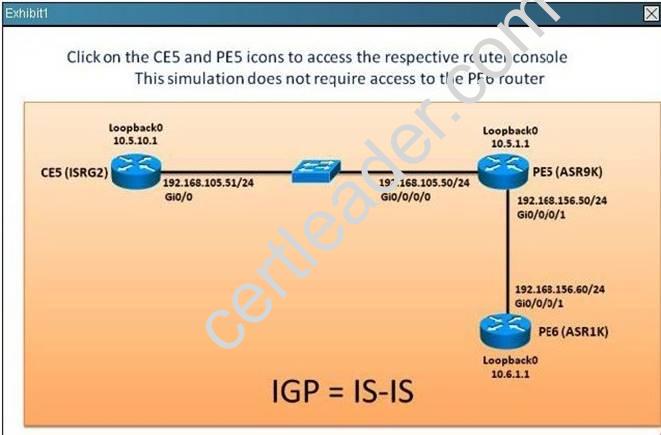

Which two statements are correct regarding the multicast operations on the router that is the RP? (Choose two.)
- A. It is using IGMPv3
- B. The IGMP query interval is set to 125 seconds
- C. It is using the IPv4 unicast routing table to perform the RPF checks
- D. Static multicast routes are configured on the RP
Answer: AC
Explanation:
#show ip mroute
#show ip pim interface
#show ip igmp group
#show ip pim neighbor
NEW QUESTION 19
Which keyword is used in the syntax to refer to Cisco IOS XR address-family groups, session groups, or neighbor groups?
- A. inherit
- B. apply
- C. use
- D. commit
Answer: C
NEW QUESTION 20
Refer to the exhibit. R2cannot to learn RP information from XR3. Which issue is the source of the problem?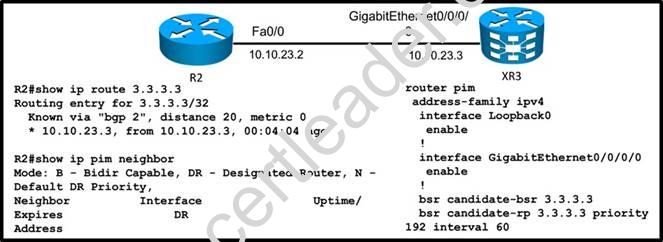
- A. XR3 is not the DR.
- B. Multicast routing is not enabled on the XR3 Giga0/0/0/0 interface.
- C. R2 is learning the RP address via non-IGP routing protocol.
- D. Multicast routing is not enabled on the XR3 Loopback0 interface.
- E. BGP IPv4 MDT address family is not enabled on XR3.
Answer: D
NEW QUESTION 21
Which difference occurs between intradomain and interdomain routing technology?
- A. PIM is used in intradomain routing technology and uses reverse path forwarding mechanism to implement optimize multicast data forwarding.
- B. MSDP is used in intradomain routing technology to discover the multicast source.
- C. Interdomain routing technology uses MSDP and M-BGP for exchanging multicast routing information.
- D. RP is not needed in intradomain routing technology, but RP is needed in interdomain routing technology to receive multicast traffic.
Answer: A
NEW QUESTION 22
......
100% Valid and Newest Version 642-885 Questions & Answers shared by Dumpscollection, Get Full Dumps HERE: https://www.dumpsolutions.com/{productsort}-dumps/ (New 131 Q&As)