What Guaranteed Cloud-Digital-Leader Training Is
Our pass rate is high to 98.9% and the similarity percentage between our Cloud-Digital-Leader study guide and real exam is 90% based on our seven-year educating experience. Do you want achievements in the Google Cloud-Digital-Leader exam in just one try? I am currently studying for the Google Cloud-Digital-Leader exam. Latest Google Cloud-Digital-Leader Test exam practice questions and answers, Try Google Cloud-Digital-Leader Brain Dumps First.
Online Google Cloud-Digital-Leader free dumps demo Below:
NEW QUESTION 1
Your organization wants to optimize its use of Google Cloud’s discounts on virtual machine-based workloads. You plan to use 200 CPUs constantly for the next 3 years, and you forecast that spikes of up to 300 CPUs will occur approximately 30% of the time. What should you choose?
- A. 1-year committed use discount for 200 CPUs
- B. 3-year committed use discount for 300 CPUs
- C. 3-year committed use discount for 200 CPUs
- D. Regular pay-as-you-go pricing
Answer: C
Explanation:
you can get a 57% discount by agreeing to commit to a 3-year contract. Any usage over the commitment will just be billed at the standard rate. Since they only need 300 CPUs 30% of the time, will pick answer C so that we are not paying usage off 300 CPUs all of the time. This gives us a discount of 57% for 200 CPU's, huge cost savings.
NEW QUESTION 2
Which Google Cloud service or feature lets you build machine learning models using Standard SQL and data in a data warehouse?
- A. BigQuery ML
- B. TensorFlow
- C. AutoML Tables
- D. Cloud Bigtable ML
Answer: A
Explanation:
BigQuery ML lets you create and execute machine learning models in BigQuery using standard SQL queries.
Reference: https://cloud.google.com/bigquery-ml/docs/introduction#:~:text=BigQuery%20ML%20lets%20you%20create,the%20need%20 to%20move%20data
Graphical user interface, text, application, email Description automatically generated
https://cloud.google.com/bigquery-ml/docs/introduction
NEW QUESTION 3
While on-premise, an enterprise had multiple teams, each with its own analytics data store. Attempts to converge the storage for centralized, company-wide analysis failed because of speed and scaling issues. What would be the preferred destination architecture on Google Cloud?
- A. Migrate to Bigtable which provides high throughput reads and writes.
- B. Migrate to Cloud Spanner as a globally scalable SQL database.
- C. Migrate to BigQuery as a central data warehouse.
- D. Migrate to Cloud SQL which supports multiple databases like MySQL, PostgreSQL, and SQL Server - all of the customer's SQL databases can be accommodated here.
Answer: C
Explanation:
BigQuery is the data warehousing option on Google Cloud. Since the source data has already been used for analysis, it should easily fit the BigQuery structure too.
NEW QUESTION 4
Which Google Cloud product or feature makes specific recommendations based on security risks and compliance violations?
- A. Google Cloud firewalls
- B. Security Command Center
- C. Cloud Deployment Manager
- D. Google Cloud Armor
Answer: B
Explanation:
Reference: https://cloud.google.com/security-command-center
Security Command Center is Security and risk management platform for Google Cloud.
Reference link- https://cloud.google.com/security-command-center
NEW QUESTION 5
A retail organization has moved all of their inventory data to a relational database in the cloud.
What functionality does a relational database offer?
- A. It analyzes unstructured data which can then be accessed in multiple regions
- B. It stores transactional data which can then be accessed electronically
- C. It stores large amounts of raw data in its original format
- D. It rapidly analyzes large and multi-dimensional datasets
Answer: B
Explanation:
A relational database offers the functionality of storing transactional data, which can then be accessed electronically. Relational databases store structured data that can be organized in tables with defined relationships between them. This makes them well- suited for transactional data, such as inventory data, that needs to be accessed and updated frequently.
NEW QUESTION 6
What issues can arise when organizations integrate third-party systems into their cloud infrastruc-ture?
- A. Third-party systems may not be powerful enough to run many critical business applications.
- B. Without sufficient security measures and regular checks, unsecured third-party systems can pose a threat to data security.
- C. Over-reliance on third-party systems limits an organization's potential for innova-tion.
- D. Third-party systems are less capable of addressing an organization's security re- quirements.
Answer: B
Explanation:
Because unsecured third-party systems are a cybersecurity threat.
NEW QUESTION 7
A customer in the European Union region is very clear that their data should not go outside the Eu-ropean Union. Their end users are spread all over the European U. They have to choose a storage option that serves all the users within Asia via web browsers as quickly as possible. Which storage option will work for them?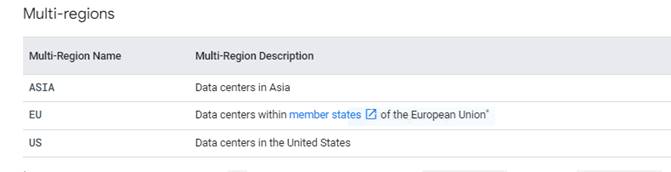
- A. Cloud Storage with a single region that is known to be within the European U
- B. Cloud Filestore is connected to virtual machines which are guaranteed to be within the European U
- C. Cloud Storage with the multi-region option of European U
- D. Cloud Storage with the dual-region option of European U
Answer: C
Explanation:
Multi-region option will use multiple datacenters that are within the European Union. More regions will also help with lower latency since users are spread across the European U.
https://cloud.google.com/storage/docs/locations#considerations
NEW QUESTION 8
Your organization is developing a plan for migrating to Google Cloud.
What is a best practice when initially configuring your Google Cloud environment?
- A. Create a project via Google Cloud Console per department in your company
- B. Define your resource hierarchy with an organization node on top
- C. Create projects based on tem members’ requests
- D. Make every member of your company the project owner
Answer: B
Explanation:
The Organization resource is the root node of the Google Cloud resource hierarchy and all resources that belong to an organization are grouped under the organization node. This provides central visibility and control over every resource that belongs to an organization.
Reference link- https://cloud.google.com/resource-manager/docs/cloud-platform-resource- hierarchy
NEW QUESTION 9
As your organization increases its release velocity, the VM-based application upgrades take a long time to perform rolling updates due to OS boot times. You need to make the application deployments faster.
What should your organization do?
- A. Migrate your VMs to the cloud, and add more resources to them
- B. Convert your applications into containers
- C. Increase the resources of your VMs
- D. Automate your upgrade rollouts
Answer: B
NEW QUESTION 10
An organization currently stores its data on-premises and they receive different levels of traffic on their website every month. How could the organization benefit from modernizing their infrastructure with cloud technology?
- A. They can rely on the cloud provider for all website source code.
- B. Agile storage scalability.
- C. 100% service availability.
- D. They can shift from heavy operational expenditure to a capital expenditure model.
Answer: B
Explanation:
Organizations can scale in the cloud by paying for what they use, when they use it.
NEW QUESTION 11
In terms of Infrastructure as a Service (IaaS) what are the benefits of it?
- A. IaaS offers virtually infinite flexibility and scalability, enterprises can get their work done more efficiently, ensuring faster development life cycles.
- B. IaaS resources are regularly available to businesses when they need the
- C. As a result, enterprises reduce delays when expanding infrastructure and, alternatively, don’t waste resources by overbuilding capacity.
- D. IaaS resources are used on demand and enterprises only have to pay for the compute, storage, and networking resources that are actually used, IaaS costs are fairly predictable and can be easily contained and budgeted for.
- E. All of the Above
Answer: D
Explanation:
These are the feature of Infrastructure as a Service (IaaS) It’s economical
Because IaaS resources are used on demand and enterprises only have to pay for the compute, storage, and networking resources that are actually used, IaaS costs are fairly predictable and can be easily contained and budgeted for.
It’s efficient
IaaS resources are regularly available to businesses when they need them. As a result, enterprises reduce delays when expanding infrastructure and, alternatively, don’t waste resources by overbuilding capacity.
It boosts productivity
Because the cloud provider is responsible for setting up and maintaining the underlying physical infrastructure, enterprise IT departments save time and money and can redirect resources to more strategic activities.
It’s reliable
IaaS has no single point of failure. Even if any one component of the hardware resources fails, the service will usually still remain available.
It’s scalable
One of the biggest advantages of IaaS in cloud computing is the capability to scale the resources up and down rapidly according to the needs of the enterprise.
It drives faster time to market
Because IaaS offers virtually infinite flexibility and scalability, enterprises can get their work done more efficiently, ensuring faster development life cycles.
NEW QUESTION 12
You are a program manager within a Software as a Service (SaaS) company that offers rendering software for animation studios. Your team needs the ability to allow scenes to be scheduled at will and to be interrupted at any time to restart later. Any individual scene rendering takes less than 12 hours to complete, and there is no service-level agreement (SLA) for the completion time for all scenes. Results will be stored in a global Cloud Storage bucket. The compute resources are not bound to any single geographical location. This software needs to run on Google Cloud in a cost-optimized way.
What should you do?
- A. Deploy the application on Compute Engine using preemptible instances
- B. Develop the application so it can run in an unmanaged instance group
- C. Create a reservation for the minimum number of Compute Engine instances you will use
- D. Start more instances with fewer virtual centralized processing units (vCPUs) instead of fewer instances with more vCPUs
Answer: A
Explanation: 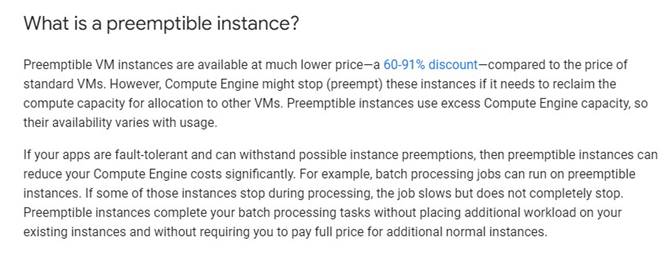
https://cloud.google.com/compute/docs/instances/preemptible
NEW QUESTION 13
What is an example of unstructured data that organizations can capture from social media?
- A. Post comments
- B. Tagging
- C. Profile picture
- D. Location
Answer: A
Explanation:
https://treehousetechgroup.com/8-examples-of-unstructured-data/
NEW QUESTION 14
An organization relies on online seasonal sales for the majority of their annual revenue. Why should the organization use App Engine for their customer app?
- A. Automatically adjusts physical inventory in real time
- B. Autoscales during peaks in demand
- C. Runs maintenance during seasonal sales
- D. Recommends the right products to customers
Answer: B
NEW QUESTION 15
An organization wants to use all available data to offer predictive suggestions on their website that improve over time.
Which method should the organization use?
- A. Data automation
- B. Trends analysis
- C. Machine learning
- D. Multiple regression
Answer: C
NEW QUESTION 16
......
100% Valid and Newest Version Cloud-Digital-Leader Questions & Answers shared by 2passeasy, Get Full Dumps HERE: https://www.2passeasy.com/dumps/Cloud-Digital-Leader/ (New 411 Q&As)