The Secret Of Microsoft DP-100 Practice Exam
Certleader offers free demo for DP-100 exam. "Designing and Implementing a Data Science Solution on Azure", also known as DP-100 exam, is a Microsoft Certification. This set of posts, Passing the Microsoft DP-100 exam, will help you answer those questions. The DP-100 Questions & Answers covers all the knowledge points of the real exam. 100% real Microsoft DP-100 exams and revised by experts!
Online DP-100 free questions and answers of New Version:
NEW QUESTION 1
Note: This question is part of a series of questions that present the same scenario. Each question in the series contains a unique solution that might meet the stated goals. Some question sets might have more than one correct solution, while others might not have a correct solution.
After you answer a question in this section, you will NOT be able to return to it. As a result, these questions will not appear in the review screen.
You are creating a model to predict the price of a student’s artwork depending on the following variables: the student’s length of education, degree type, and art form.
You start by creating a linear regression model. You need to evaluate the linear regression model.
Solution: Use the following metrics: Accuracy, Precision, Recall, F1 score and AUC. Does the solution meet the goal?
- A. Yes
- B. No
Answer: B
Explanation:
Those are metrics for evaluating classification models, instead use: Mean Absolute Error, Root Mean Absolute Error, Relative Absolute Error, Relative Squared Error, and the Coefficient of Determination.
References:
https://docs.microsoft.com/en-us/azure/machine-learning/studio-module-reference/evaluate-model
NEW QUESTION 2
You use the Azure Machine Learning designer to create and run a training pipeline.
The pipeline must be run every night to inference predictions from a large volume of files. The folder where the files will be stored is defined as a dataset.
You need to publish the pipeline as a REST service that can be used for the nightly inferencing run. What should you do?
- A. Create a batch inference pipeline
- B. Set the compute target for the pipeline to an inference cluster
- C. Create a real-time inference pipeline
- D. Clone the pipeline
Answer: A
Explanation:
Azure Machine Learning Batch Inference targets large inference jobs that are not time-sensitive. Batch Inference provides cost-effective inference compute scaling, with unparalleled throughput for asynchronous applications. It is optimized for high-throughput, fire-and-forget inference over large collections of data.
You can submit a batch inference job by pipeline_run, or through REST calls with a published pipeline. Reference:
https://github.com/Azure/MachineLearningNotebooks/blob/master/how-to-use-azureml/machine-learning-pipeli
NEW QUESTION 3
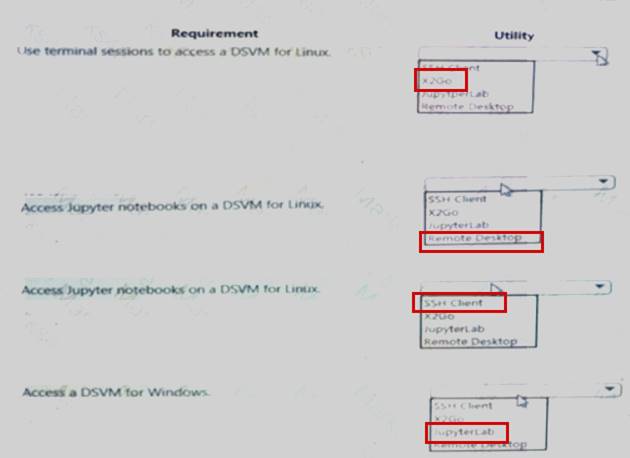
You use Data Science Virtual Machines (DSVMs) for Windows and Linux in Azure. You need to access the DSVMs.
Which utilities should you use? To answer, select the appropriate options in the answer area. NOTE: Each correct selection is worth one point.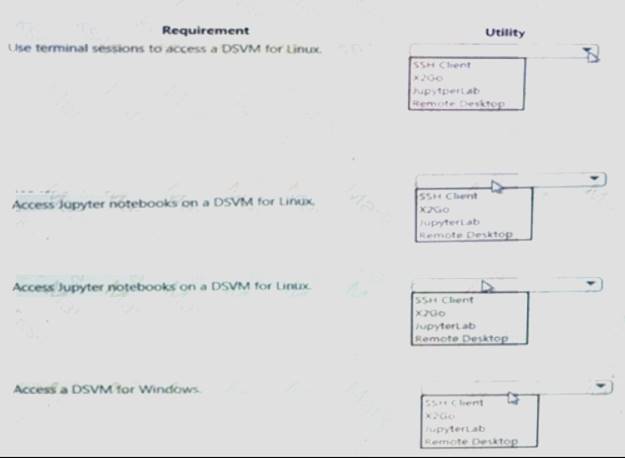
Solution:
Does this meet the goal?
- A. Yes
- B. Not Mastered
Answer: A
NEW QUESTION 4
You train and register a model in your Azure Machine Learning workspace.
You must publish a pipeline that enables client applications to use the model for batch inferencing. You must use a pipeline with a single ParallelRunStep step that runs a Python inferencing script to get predictions from the input data.
You need to create the inferencing script for the ParallelRunStep pipeline step.
Which two functions should you include? Each correct answer presents part of the solution.
NOTE: Each correct selection is worth one point.
- A. run(mini_batch) D
- B. main()
- C. batch()
- D. init()
- E. score(mini_batch)
Answer: AD
Explanation:
Reference:
https://github.com/Azure/MachineLearningNotebooks/tree/master/how-to-use-azureml/machine-learningpipelin
NEW QUESTION 5
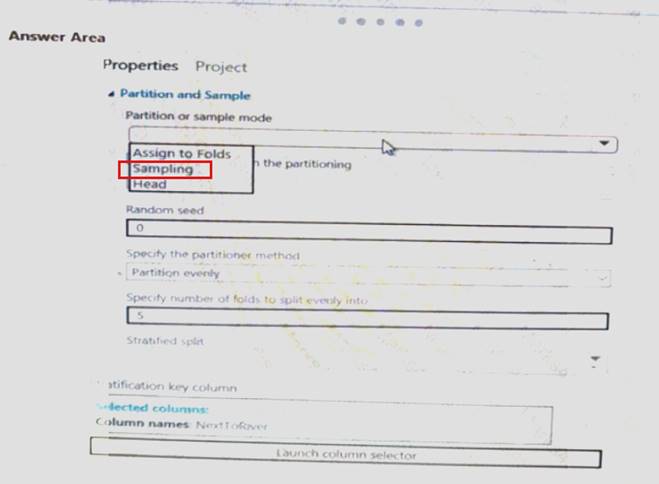
You need to identify the methods for dividing the data according, to the testing requirements.
Which properties should you select? To answer, select the appropriate option-, m the answer area. NOTE: Each correct selection is worth one point.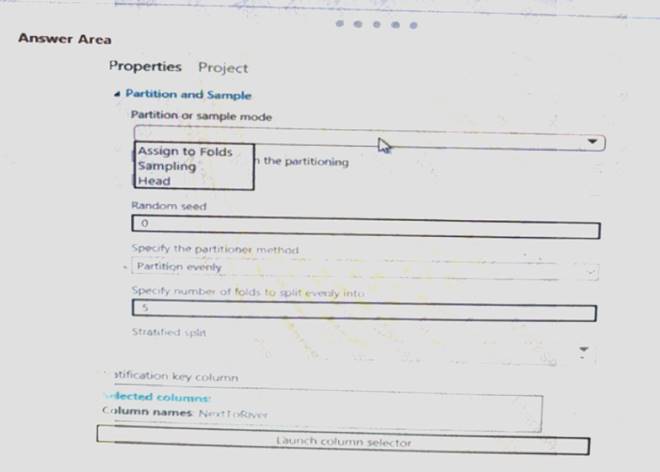
Solution:
Does this meet the goal?
- A. Yes
- B. Not Mastered
Answer: A
NEW QUESTION 6
You arc I mating a deep learning model to identify cats and dogs. You have 25,000 color images. You must meet the following requirements:
• Reduce the number of training epochs.
• Reduce the size of the neural network.
• Reduce over-fitting of the neural network.
You need to select the image modification values.
Which value should you use? To answer, select the appropriate Options in the answer area. NOTE: Each correct selection is worth one point.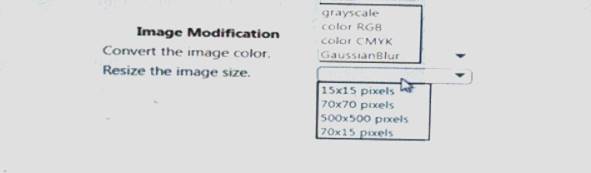
Solution:
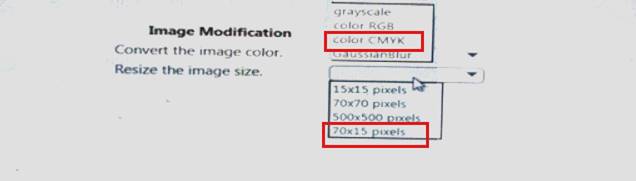
Does this meet the goal?
- A. Yes
- B. Not Mastered
Answer: A
NEW QUESTION 7
You use the Azure Machine Learning designer to create and run a training pipeline. You then create a real-time inference pipeline.
You must deploy the real-time inference pipeline as a web service.
What must you do before you deploy the real-time inference pipeline?
- A. Run the real-time inference pipeline.
- B. Create a batch inference pipeline.
- C. Clone the training pipeline.
- D. Create an Azure Machine Learning compute cluster.
Answer: D
Explanation:
You need to create an inferencing cluster. Deploy the real-time endpoint
After your AKS service has finished provisioning, return to the real-time inferencing pipeline to complete deployment. Select Deploy above the canvas. Select Deploy new real-time endpoint. Select the AKS cluster you created. Select Deploy. Reference:
https://docs.microsoft.com/en-us/azure/machine-learning/tutorial-designer-automobile-price-deploy
NEW QUESTION 8
You create a binary classification model. You need to evaluate the model performance.
Which two metrics can you use? Each correct answer presents a complete solution.
NOTE: Each correct selection is worth one point.
- A. relative absolute error
- B. precision
- C. accuracy
- D. mean absolute error
- E. coefficient of determination
Answer: BC
Explanation:
The evaluation metrics available for binary classification models are: Accuracy, Precision, Recall, F1 Score, and AUC.
Note: A very natural question is: ‘Out of the individuals whom the model, how many were classified correctly (TP)?’
This question can be answered by looking at the Precision of the model, which is the proportion of positives that are classified correctly.
References:
https://docs.microsoft.com/en-us/azure/machine-learning/studio/evaluate-model-performance
NEW QUESTION 9
You create a multi-class image classification deep learning model that uses a set of labeled images. You create a script file named train.py that uses the PyTorch 1.3 framework to train the model.
You must run the script by using an estimator. The code must not require any additional Python libraries to be installed in the environment for the estimator. The time required for model training must be minimized.
You need to define the estimator that will be used to run the script. Which estimator type should you use?
- A. TensorFlow
- B. PyTorch
- C. SKLearn
- D. Estimator
Answer: B
Explanation:
For PyTorch, TensorFlow and Chainer tasks, Azure Machine Learning provides respective PyTorch, TensorFlow, and Chainer estimators to simplify using these frameworks.
Reference:
https://docs.microsoft.com/en-us/azure/machine-learning/how-to-train-ml-models
NEW QUESTION 10
You write five Python scripts that must be processed in the order specified in Exhibit A – which allows the same modules to run in parallel, but will wait for modules with dependencies.
You must create an Azure Machine Learning pipeline using the Python SDK, because you want to script to create the pipeline to be tracked in your version control system. You have created five PythonScriptSteps and have named the variables to match the module names.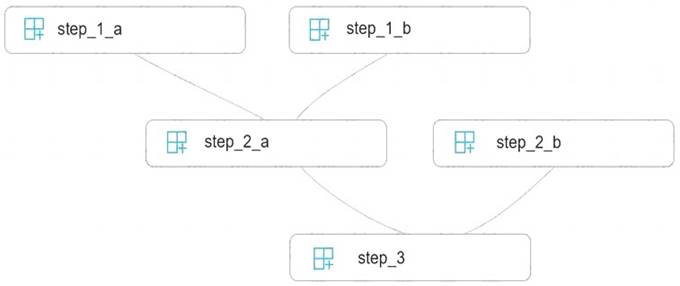
You need to create the pipeline shown. Assume all relevant imports have been done. Which Python code segment should you use?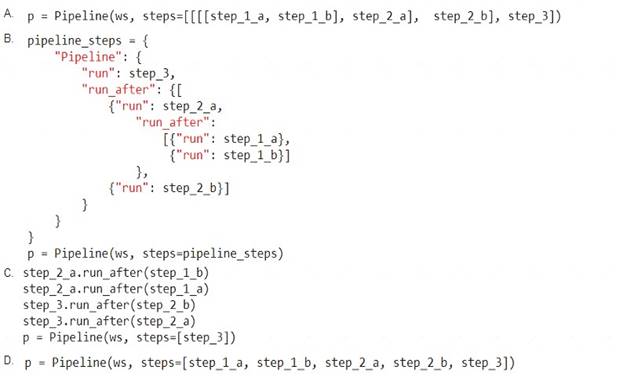
- A. Option A
- B. Option B
- C. Option C
- D. Option D
Answer: A
Explanation:
The steps parameter is an array of steps. To build pipelines that have multiple steps, place the steps in order in this array.
Reference:
https://docs.microsoft.com/en-us/azure/machine-learning/how-to-use-parallel-run-step
NEW QUESTION 11
You are performing a classification task in Azure Machine Learning Studio.
You must prepare balanced testing and training samples based on a provided data set. You need to split the data with a 0.75:0.25 ratio.
Which value should you use for each parameter? To answer, select the appropriate options in the answer area.
NOTE: Each correct selection is worth one point.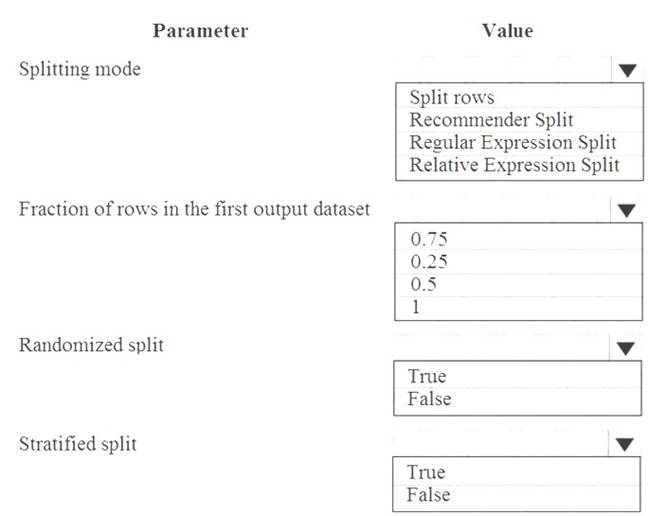
Solution:
Box 1: Split rows
Use the Split Rows option if you just want to divide the data into two parts. You can specify the percentage of data to put in each split, but by default, the data is divided 50-50.
You can also randomize the selection of rows in each group, and use stratified sampling. In stratified sampling, you must select a single column of data for which you want values to be apportioned equally among the two result datasets.
Box 2: 0.75
If you specify a number as a percentage, or if you use a string that contains the "%" character, the value is interpreted as a percentage. All percentage values must be within the range (0, 100), not including the values 0 and 100.
Box 3: Yes
To ensure splits are balanced.
Box 4: No
If you use the option for a stratified split, the output datasets can be further divided by subgroups, by selecting a strata column.
Reference:
https://docs.microsoft.com/en-us/azure/machine-learning/studio-module-reference/split-data
Does this meet the goal?
- A. Yes
- B. Not Mastered
Answer: A
NEW QUESTION 12
You need to build a feature extraction strategy for the local models.
How should you complete the code segment? To answer, select the appropriate options in the answer area. NOTE: Each correct selection is worth one point.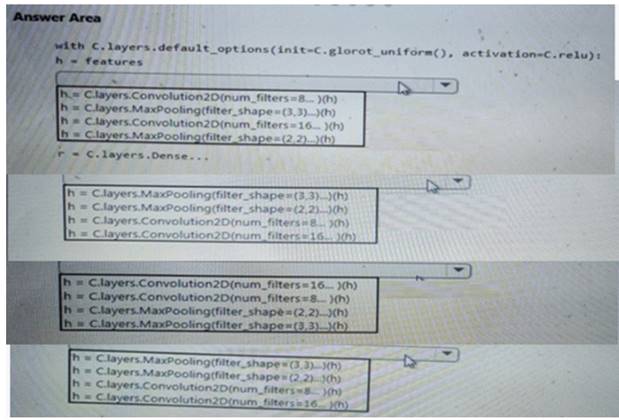
Solution:
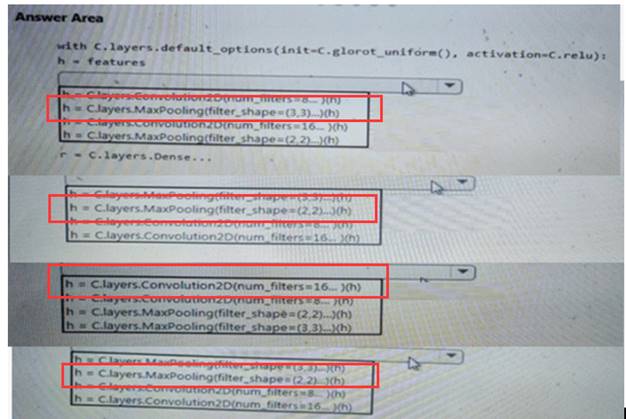
Does this meet the goal?
- A. Yes
- B. Not Mastered
Answer: A
NEW QUESTION 13
Note: This question is part of a series of questions that present the same scenario. Each question in the series contains a unique solution that might meet the stated goals. Some question sets might have more than one correct solution, while others might not have a correct solution.
After you answer a question in this section, you will NOT be able to return to it. As a result, these questions will not appear in the review screen.
You are creating a new experiment in Azure Machine Learning Studio.
One class has a much smaller number of observations than the other classes in the training set. You need to select an appropriate data sampling strategy to compensate for the class imbalance. Solution: You use the Stratified split for the sampling mode.
Does the solution meet the goal?
- A. Yes
- B. No
Answer: B
Explanation:
Instead use the Synthetic Minority Oversampling Technique (SMOTE) sampling mode.
Note: SMOTE is used to increase the number of underepresented cases in a dataset used for machine learning. SMOTE is a better way of increasing the number of rare cases than simply duplicating existing cases.
References:
https://docs.microsoft.com/en-us/azure/machine-learning/studio-module-reference/smote
NEW QUESTION 14
You are using a Git repository to track work in an Azure Machine Learning workspace. You need to authenticate a Git account by using SSH.
Which three actions should you perform in sequence? To answer, move the appropriate actions from the list of actions to the answer area and arrange them in the correct order.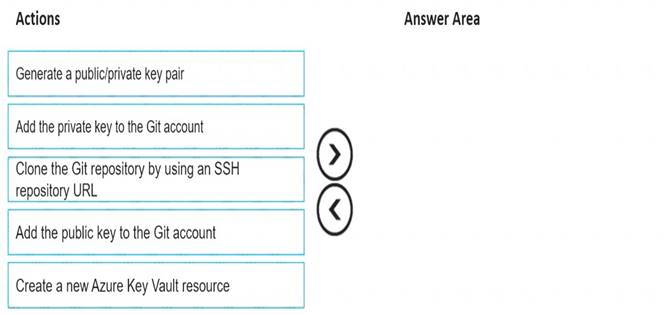
Solution:
Graphical user interface, text, application, chat or text message Description automatically generated
Authenticate your Git Account with SSH: Step 1: Generating a public/private key pair Generate a new SSH key
* 1. Open the terminal window in the Azure Machine Learning Notebook Tab.
* 2. Paste the text below, substituting in your email address. ssh-keygen -t rsa -b 4096 -C "your_email@example.com"
This creates a new ssh key, using the provided email as a label.
> Generating public/private rsa key pair.
Step 2: Add the public key to the Git Account
In your terminal window, copy the contents of your public key file. Step 3: Clone the Git repository by using an SSH repository URL
* 1. Copy the SSH Git clone URL from the Git repo.
* 2. Paste the url into the git clone command below, to use your SSH Git repo URL. This will look something like:
git clone git@example.com:GitUser/azureml-example.git Cloning into 'azureml-example'.
Reference:
https://docs.microsoft.com/en-us/azure/machine-learning/concept-train-model-git-integration
Does this meet the goal?
- A. Yes
- B. Not Mastered
Answer: A
NEW QUESTION 15
You need to define a modeling strategy for ad response.
Which three actions should you perform in sequence? To answer, move the appropriate actions from the list of actions to the answer area and arrange them in the correct order.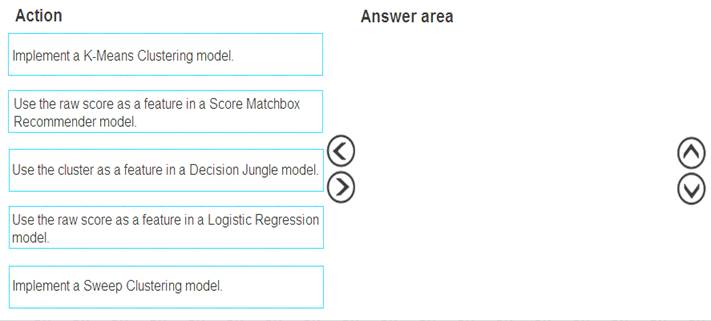
Solution:
Step 1: Implement a K-Means Clustering model
Step 2: Use the cluster as a feature in a Decision jungle model.
Decision jungles are non-parametric models, which can represent non-linear decision boundaries. Step 3: Use the raw score as a feature in a Score Matchbox Recommender model
The goal of creating a recommendation system is to recommend one or more "items" to "users" of the system. Examples of an item could be a movie, restaurant, book, or song. A user could be a person, group of persons, or other entity with item preferences.
Scenario:
Ad response rated declined.
Ad response models must be trained at the beginning of each event and applied during the sporting event. Market segmentation models must optimize for similar ad response history.
Ad response models must support non-linear boundaries of features. References:
https://docs.microsoft.com/en-us/azure/machine-learning/studio-module-reference/multiclass-decision-jungle https://docs.microsoft.com/en-us/azure/machine-learning/studio-module-reference/score-matchbox-recommende
Does this meet the goal?
- A. Yes
- B. Not Mastered
Answer: A
NEW QUESTION 16
You are creating a classification model for a banking company to identify possible instances of credit card fraud. You plan to create the model in Azure Machine Learning by using automated machine learning.
The training dataset that you are using is highly unbalanced. You need to evaluate the classification model.
Which primary metric should you use?
- A. normalized_mean_absolute_error
- B. [spearman_correlation
- C. AUC.weighted
- D. accuracy
- E. normalized_root_mean_squared_error
Answer: C
Explanation:
AUC_weighted is a Classification metric.
Note: AUC is the Area under the Receiver Operating Characteristic Curve. Weighted is the arithmetic mean of the score for each class, weighted by the number of true instances in each class.
Reference:
https://docs.microsoft.com/en-us/azure/machine-learning/how-to-understand-automated-ml
NEW QUESTION 17
You are planning to register a trained model in an Azure Machine Learning workspace.
You must store additional metadata about the model in a key-value format. You must be able to add new metadata and modify or delete metadata after creation.
You need to register the model. Which parameter should you use?
- A. description
- B. model_framework
- C. cags
- D. properties
Answer: D
Explanation:
azureml.core.Model.properties:
Dictionary of key value properties for the Model. These properties cannot be changed after registration, however new key value pairs can be added.
Reference:
https://docs.microsoft.com/en-us/python/api/azureml-core/azureml.core.model.model
NEW QUESTION 18
......
Recommend!! Get the Full DP-100 dumps in VCE and PDF From Dumpscollection.com, Welcome to Download: https://www.dumpscollection.net/dumps/DP-100/ (New 442 Q&As Version)