Down To Date 1Z0-821 Practice Exam 2021
Exam Code: 1Z0-821 (Practice Exam Latest Test Questions VCE PDF)
Exam Name: Oracle Solaris 11 System Administrator
Certification Provider: Oracle
Free Today! Guaranteed Training- Pass 1Z0-821 Exam.
NEW QUESTION 1
Review the ZFS dataset output that is displayed on your system: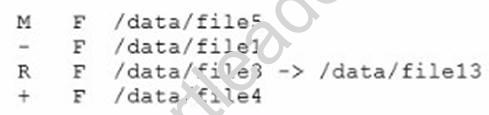
Which four correctly describe the output?
- A. /data/file4 has been added.
- B. The link /data/file3 has been added.
- C. /data/file3 has been renamed to /data/file13.
- D. /data/file4 has been modified and is now larger.
- E. /data/file1 has been deleted.
- F. /data/file1 has been modified and is now smaller.
- G. /data/file5 has been modified.
- H. /data/file3 (a link) has been removed.
Answer: ACEG
Explanation:
A: + Indicates the file/directory was added in the later dataset
C: R Indicates the file/directory was renamed in the later dataset E: - Indicates the file/directory was removed in the later dataset
G: M Indicates the file/directory was modified in the later dataset
Note: Identifying ZFS Snapshot Differences (zfs diff)
You can determine ZFS snapshot differences by using the zfs diff command.
The following table summarizes the file or directory changes that are identified by the zfs diff command.
File or Directory Change Identifier
* File or directory is modified or file or directory link changed M
* File or directory is present in the older snapshot but not in the newer snapshot
—
* File or directory is present in the newer snapshot but not in the older snapshot
+
* File or directory is renamed R
NEW QUESTION 2
The current ZFS configuration on your server is:
pool1 124K 3.91G 32K /pool1 pool1/data 31K 3.91G 31K /data
You need to create a new file system named /data2. /data2 will be a copy of the /data file system.
You need to conserve disk space on this server whenever possible.
Which option should you choose to create /data2, which will be a read writeable copy of the
/data file system, while minimizing the amount of total disk space used in pool1?
- A. zfs set mountpoint=/data2 compression=on pool1/data2
- B. zfs snapshot pool1/data@nowzfs set mountpoint=/data2, comptession=on pool1/data@now
- C. zfs create snapshot pool1/data@nowzfs send pool1/data@now | zfs recv pool1/data2
- D. zfs create snapshot pool1/data@nowzfs clone -o mountpoint=/data2 pool1/data@now pool1/data2
- E. zfs snapshot pool1/data@nowzfs clone -o mountpoint=/data2 -ocompression=on pool1/data@now pool1/data2
- F. zfs snapshot pool1/data@nowzfs clone -o mountpoint=/data2 pool1/data@now pool1/data2
Answer: E
Explanation:
zfs snapshot [-r] [-o property=value] ... filesystem@snapname|volume@snapname Creates a snapshot with the given name. All previous modifications by successful system calls to the file system are part of the snapshot
zfs clone [-p] [-o property=value] ... snapshot filesystem|volume Creates a clone of the given snapshot.
Note:
Because snapshots are fast and low overhead, they can be used extensively without great concern for system performance or disk use .
With ZFS you can not only create snapshot but create a clone of a snapshot.
A clone is a writable volume or file system whose initial contents are the same as the dataset from which it was created. As with snapshots, creating a clone is nearly instantaneous, and initially consumes no additional disk space. In addition, you can snapshot a clone.
A clone is a writable volume or file system whose initial contents are the same as the original dataset. As with snapshots, creating a clone is nearly instantaneous, and initially consumes no additional space.
Clones can only be created from a snapshot. When a snapshot is cloned, it creates an implicit dependency between the parent and child.
NEW QUESTION 3
What determines which bits in an IP address represent the subnet, and which represent the host?
- A. Subnet
- B. unicast
- C. netmask
- D. multicast
- E. broadcast
Answer: C
Explanation:
A subnetwork, or subnet, is a logically visible subdivision of an IP network. The practice of dividing a network into two or more networks is called subnetting.
The routing prefix of an address is written in a form identical to that of the address itself. This is called the network mask, or netmask, of the address. For example, a specification of the most-significant 18 bits of an IPv4 address, 11111111.11111111.11000000.00000000, is written as 255.255.192.0.
NEW QUESTION 4
A user brian is configured to use the bash shell. His home directory is /export/home/brian, and contains a .profile and a .bashrc file.
In the -profile, there are these lines: genius =ritchie
export genius
In the .bashrc us this line: genius=kernighan
In /etc/profile are these lines: genius=thompson
export genius
When brian logs in and asks for the value of genius, what will he find, and why?
- A. genius will be ritchie, because that was the value exported in .profile.
- B. genius will be kernighan, because .bashrc executes after .profile.
- C. genius will be ritchie because variable settings in .profile take precedence over variable settings in .bashrc.
- D. genius will be ritchie because .profile executes after .bashrc.
- E. genius will be thompson because /etc/profile system settings always override local settings.
Answer: C
NEW QUESTION 5
Examine this command and its output:
$ zfs list -r -t all tank
Name USED AVAIL REFER MOUNTPOINT
tank 3.00G 1.84G 32K /tank
tank/database 3.00G 1.84G 2.00G /tank/database tank/[email protected] 1.00G - 2.00G –
Which two conclusions can be drawn based on this output?
- A. The tank dataset consumes 3 GB of storage.
- B. The tank/[email protected] dataset consumes 1 GB of storage that is shared with its parent.
- C. The tank/[email protected] dataset consumes 1 GB of storage that is not shared with its parent.
- D. The tank/[email protected] dataset consumes 2 GB of storage that is shared with its child.
- E. The tank/[email protected] dataset consumes 2 GB of storage that is not shared with its child.
Answer: AB
NEW QUESTION 6
You want to display network interface information. Which command should you use?
- A. ipadm show-if
- B. ipadm show-addr
- C. ipadm show-prop
- D. ipadm show-addrprop
Answer: A
NEW QUESTION 7
You are asked to troubleshoot networking issues on an unfamiliar system. Select the correct command to display what network devices are installed.
- A. ifconfig -a
- B. dladm show-dev
- C. dladm show-phys
- D. dladm show-ether
- E. netadm show-dev
- F. netadm show-ether
Answer: C
NEW QUESTION 8
You need to set up a local package repository to serve 75 client systems. Multiple clients will being the package repository concurrently and you need to ensure that the local repository performs very well under this heavy load, especially during package intensive operations.
Which option would ensure the best performance of the repository during package-
intensive rations by multiple clients?
- A. Set up multipathing on the package repository server to distribute the network load multiple network interfaces.
- B. Deploy a second instance of the package repository server to run as a read writable mirror.
- C. Deploy a second instance of the package repository server to run as a read-only mirror.
- D. Deploy a second instance of the package repository server to run as a clone of the primary repository server.
- E. Deploy a package repository locally on each client.
Answer: A
NEW QUESTION 9
The OpenBoot firmware controls the operation of the system before the operating system is loaded.
Which four tasks are directly controlled by the OpenBoot firmware?
- A. Provides a list of boot entries from which to choose
- B. Allows hardware to identify itself and load its own plug-in device driver
- C. Loads the boot loader from the configured boot device
- D. Performs basic hardware testing
- E. Installs the console
- F. Reads and executes the boot archive
- G. Extract and executes the kernel image
Answer: ABCD
Explanation:
OpenBoot firmware is executed immediately after you turn on your system. The primary tasks of OpenBoot firmware are to:
* Test and initialize the system hardware (D)
* Determine the hardware configuration (D)
*Boot the operating system from either a mass storage device or from a network
*Provide interactive debugging facilities for testing hardware and software
Some notable features of OpenBoot firmware.
* Plug-in Device Drivers (B)
Most common tasks that you perform using OpenBoot
* Booting Your System
The most important function of OpenBoot firmware is to boot the system.
Note: If auto-boot? is true, the system will boot from either the default boot device or from the diagnostic boot device depending on whether OpenBoot is in diagnostic mode. (C)
NEW QUESTION 10
You want to display the IP address assignments of the network interfaces. Which command should you use?
- A. ipadm show-if
- B. ipadm show-addr
- C. ipadm show-prop
- D. ipadm show-addrprop
Answer: B
Explanation:
'ipadm show-addr' displays all the configured addresses on the system. Example:
# ipadm show-addr
ADDROBJ TYPE STATE ADDR
lo0/v4 static ok 127.0.0.1/8 lo0/v6 static ok ::1/128
NEW QUESTION 11
Which statement is correct about shudown and init commands?
- A. shutdown broadcasts one or more periodic shutdown warning messages to all logged-in users whereas init issues none.
- B. The shutdown command performs a clean shutdown of all services whereas init does not.
- C. The shutdown command brings the system to the single-user milestone by defaul
- D. The init command must be used to shut the system down to run level 0.
- E. The shutdown command accepts SMF milestones, init stages, or run levels as arguments whereas init accepts only init stages or run levels as arguments.
Answer: A
NEW QUESTION 12
Review the storage pool information: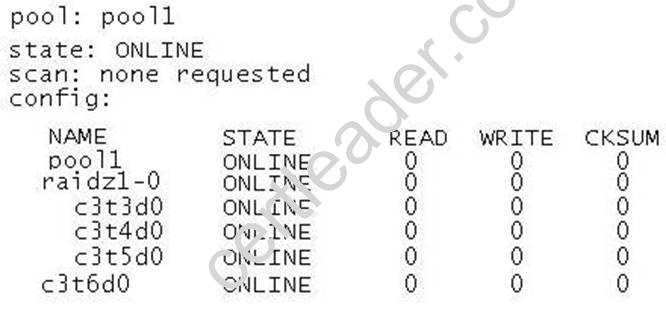
Which statement describes the status of this storage pool?
- A. It is a RAIDZ storage pool and can withstand a single disk failure; data will be striped at: disk components.
- B. It is a double-parity RAIDZ storage pool and can withstand two disk failures; data will be striped across four disk components.
- C. It is an improperly configured RAIDZ storage pool; data will be striped across four disk components, but only three drives are protected with redundancy.
- D. It is an improperly configured RAIDZ storage pool; data will be striped across three disk components, but only three drives are protected with redundancy.
Answer: D
Explanation:
Device c3t6d0 is not included in the RAIDZ storage pool. The other three devices are included in the raidz pool. The data on these devices are protected.
Note: In addition to a mirrored storage pool configuration, ZFS provides a RAID-Z configuration with either single, double, or triple parity fault tolerance. Single-parity RAID-Z (raidz or raidz1) is similar to RAID-5. Double-parity RAID-Z (raidz2) is similar to RAID-6.
NEW QUESTION 13
Consider the following commands: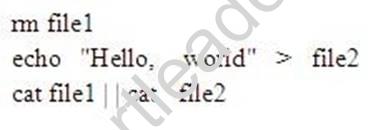
What is displayed when this sequence of commands is executed using the bash shell?
- A. Hello, world
- B. cat: cannot open file1: No such file or directory Hello, world
- C. cat: cannot open file1: No such file or directory
- D. bash: syntax error near unexpected token '| |'
- E. bash: syntax error broker pipe
Answer: B
NEW QUESTION 14
You have been tasked with creating a dedicated virtual network between two local zones within a single system. In order to isolate the network traffic from other zones on that system.
To accomplish this, you will create .
- A. An ether stub
- B. A virtual router
- C. A virtual switch
- D. A virtual bridge.
- E. A virtual network interface
- F. Nothing because a virtual switch is automatically created then the virtual network interfaces are created.
Answer: A
Explanation:
Etherstubs are pseudo ethernet NICs which are managed by the system administrator. You can create VNICs over etherstubs instead of over physical links. VNICs over an etherstub become independent of the physical NICs in the system. With etherstubs, you can construct a private virtual network that is isolated both from the other virtual networks in the system and from the external network. For example, you want to create a network environment whose access is limited only to your company developers than to the network at large. Etherstubs can be used to create such an environment.
Note: Oracle Solaris 11 introduces a new and powerful network stack architecture which includes:
* Networking virtualization with virtual network interface cards (VNICs) and virtual switching (etherstubs)
* Tight integration with zones
* Network resource management - efficient and easy to manage integrated quality of service (QoS) to enforce bandwidth limit on VNICs and traffic flows
NEW QUESTION 15
A datalink can best be described as .
- A. a driver for a Network Interface Card
- B. the software connecting the Internet Layer and the Physical Layer
- C. a device that provides Classless Inter-Domain Routing
- D. a logical object used for IP Multipathing
Answer: D
Explanation:
The command dladm is used to configure data-link interfaces in Sun Solaris. A configured data-link is represented in the system as interface that can be used for TCP/IP. Each data- link relies on either a single network device or an link aggregation device to send & recieve packets.
Network interfaces provide the connection between the system and the network. These interfaces are configured over data links, which in turn correspond to instances of hardware devices in the system.
In the current model of the network stack, interfaces and links on the software layer build on the devices in the hardware layer. More specifically, a hardware device instance in the
hardware layer has a corresponding link on the data-link layer and a configured interface on the interface layer. This one-to-one relationship among the network device, its data link, and the IP interface is illustrated in the figure that follows.
Network Stack Showing Network Devices, Links, and Interfaces: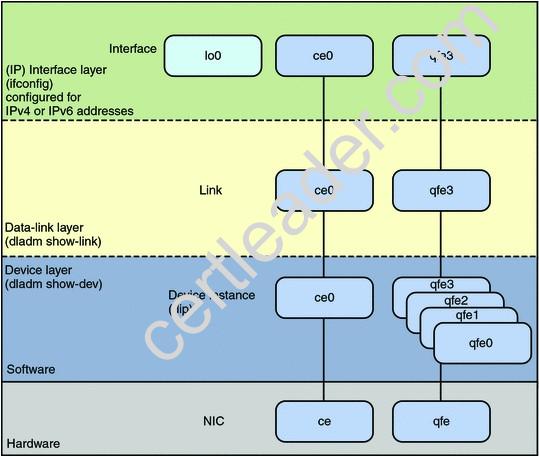
NEW QUESTION 16
Which network protocol is responsible for routing packets from one network to another?
- A. TCP
- B. UDP
- C. IP
- D. ICMP
- E. Ethernet
Answer: C
Explanation:
The Internet Protocol (IP) is the principal communications protocol in the Internet protocol suite for relaying datagrams across network boundaries. Its routing function enables internetworking, and essentially establishes the Internet.
NEW QUESTION 17
You have been tasked with creating a dedicated virtual network between two local zones within a single system, in order to isolate the network traffic from other zones on that system.
To accomplish this, you will create .
- A. an ether stub
- B. virtual router
- C. a virtual bridge
- D. a virtual network interface
- E. nothing, because a virtual switch is automatically created when the virtual network interfaces are created
Answer: D
Explanation:
First create a virtual switch, then create a virtual network interface.
NEW QUESTION 18
Identify three options that describe the new Oracle Solaris 11 zone features.
- A. There are boot environments for zones.
- B. Administrators can delegate common administration tasks by using RBAC.
- C. Oracle Solaris 11 supports Solaris 8, 9, and 10 branded zones.
- D. You can migrate a physical Solaris 10 system and its non-global zones to a solaris10 branded zone running on an Oracle Solaris 11 system.
- E. It is possible to change the host ID of a zone.
Answer: ABD
Explanation:
A: The beadm utility includes support for creating and administering non-global zone boot environments.
Note: A boot environment is a bootable instance of the Oracle Solaris operating system image plus any other application software packages installed into that image. System administrators can maintain multiple boot environments on their systems, and each boot environment can have different software versions installed.
B: Role-based access control (RBAC) is a security feature for controlling user access to tasks that would normally be restricted to the root role. By applying security attributes to processes and to users, RBAC can divide up superuser capabilities among several administrators.
NEW QUESTION 19
Which modification needs to be made to the Service Management Facility before you publish a new package to the IPS repository?
- A. The pkg.depotd must be disabled.
- B. The pkg/readonly property for the application/pkg/server service must be set to false.
- C. The Pkg/writabie_root property for the application/Pkg/server service must be set to true.
- D. The pkg/image.root property for the application/pkg/server service must be set to the location of the repository.
Answer: D
Explanation:
pkg/image_root
(astring) The path to the image whose file information will be used as a cache for file data.
NEW QUESTION 20
In Oracle Solaris 11, where is the Oracle default repository located?
- A. /var/spool/pkg
- B. http://localhost/solaris
- C. http://pkg.oracle.com/solaris/release
- D. http://www.oracle.com/Solaris/download
- E. /cdrom/cdrom0
Answer: C
Explanation:
REPOSITORY DESCRIPTION
* http://pkg.oracle.com/solaris/release
The default repository for new Oracle Solaris 11 users. This repository receives updates for each new release of Oracle Solaris. Significant bug fixes, security updates, and new software may be provided at any time for users to install at Oracle's discretion.
*https://pkg.oracle.com/solaris/support
Provides bug fixes and updates. Accessible with a current support contract from Oracle.
* https://pkg.oracle.com/solaris/dev Provides the latest development updates. Accessible to users enrolled in the Oracle Solaris 11 Platinum Customer Program and approved Oracle Partners.
NEW QUESTION 21
Which two options are characteristics of a fast reboot?
- A. A fast reboot bypasses grub.
- B. A fast reboot cannot be used after a system panic on the x86 platform.
- C. A fast reboot can only be executed on the SPARC platform when the config/fastreboot_default property for the svc:/system/boot-config:default service is set to true.
- D. A fast reboot uses an in-kernel boot loader to load the kernel into memory.
- E. A fast reboot is the default on all platforms.
Answer: CD
Explanation:
C: To change the default behavior of the Fast Reboot feature on the SPARC platform, so that a fast reboot is automatically performed when the system reboots, see below.
The following example shows how to set the property's value to true on the SPARC platform, so that a fast reboot is initiated by default:
# svccfg -s "system/boot-config:default" setprop config/fastreboot_default=true
# svcadm refresh svc:/system/boot-config:default
D: Fast Reboot implements an in-kernel boot loader that loads the kernel into memory and then switches to that kernel.
The firmware and boot loader processes are bypassed, which enables the system to reboot within seconds.
The Fast Reboot feature is managed by SMF and implemented through a boot configuration service, svc:/system/boot-config. The boot-config service provides a means for setting or changing the default boot configuration parameters. When the config/fastreboot_default property is set to true, the system performs a fast reboot automatically, without the need to use the reboot -f command. This property's value is set to true on the x86 platform. For task-related information, including how to change the default behavior of Fast Reboot on the SPARC platform, see Accelerating the Reboot Process on an x86 Based System.
Note: One new feature, called Fast Reboot, will allow the system to boot up without doing the routine set of hardware checks, a move that can make system boot times up to two- and-a-half times faster, Oracle claimed. This feature can be handy in that an administrator applying a patch or software update across thousands of Solaris deployments can reboot them all the more quickly.
NEW QUESTION 22
You have Solaris 11 system with a host name of sysA and it uses LDAP as a naming service.
You have created a flash archive of sysA and you want to migrate this system to an Oracle Solaris11 server, Solaris10 branded zone.
The zone Status on the Oracle Solaris 11 server is:
- zone10 incomplete/zone/zone1solaris10exc1
Select the option that will force the non-global zone to prompt you for a host name and name service the first time it is booted.
- A. Use zonecfg to change the zonename before booting the system for the first time
- B. Use the - u option with the zoneadm - z zone10 attach command.
- C. Use the -u option with the zoneadn -z zone10 install command.
- D. Remove the sysidcfg file from the <zonepath>/root directory before booting the non- global zone.
Answer: C
Explanation:
Oracle Solaris 10 branded zones – Oracle Solaris 10 Zones provide an Oracle Solaris 10
environment on Oracle Solaris 11. You can migrate an Oracle Solaris 10 system or zone to a solaris10 zone on an Oracle Solaris 11 system in the following ways:
* Create a zone archive and use the archive to create an s10zone on the Oracle Solaris 11 system.
This option applies in the current scenario.
Example of command to Install the Oracle Solaris 10 non-global zone. s11sysB# zoneadm -z s10zone install -u -a /pond/s10archive/s10.flar
* Detach the zone from the Oracle Solaris 10 system and attach the zone on the Oracle Solaris 11 zone. The zone is halted and detached from its current host. The zonepath is moved to the target host, where it is attached.
Note:
install [-x nodataset] [brand-specific options] A subcommand of the zoneadm.
Install the specified zone on the system. This subcommand automatically attempts to verify first. It refuses to install if the verify step fails.
-u uuid-match
Unique identifier for a zone, as assigned by libuuid(3LIB). If this option is present and the argument is a non-empty string, then the zone matching the UUID is selected instead of the one named by the -z option, if such a zone is present.
NEW QUESTION 23
You have a process called bigscript, and you need to know the PID number for this process.
Which command will provide that information?
- A. pkill bigscript
- B. ps bigscript
- C. pgrep bigscript
- D. prstat bigscript
Answer: C
Explanation:
Pgrep takes a process name and return a PID.
Note: pgrep looks through the currently running processes and lists the process IDs which matches the selection criteria to stdout. All the criteria have to match. For example, pgrep - u root sshd will only list the processes called sshd AND owned by root.
Incorrec answers:
ps bigscript: You can’t pass a name to ps, it interprets it as arguments.
NEW QUESTION 24
Review the information taken from your server: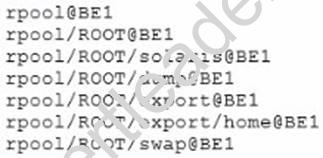
Which option describes the command used to create these snapshots of the root file system?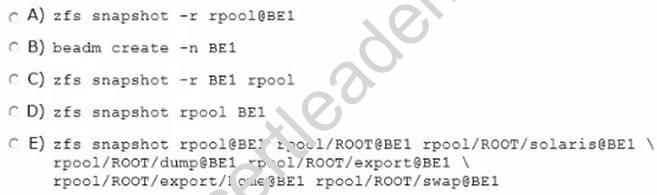
- A. Option A
- B. Option B
- C. Option C
- D. Option D
Answer: A
Explanation:
zfs snapshot [-r] [-o property=value] ... filesystem@snapname|volume@snapname Creates a snapshot with the given name. All previous modifications by successful system calls to the file system are part of the snapshot. See the “Snapshots” section for details.
-r
Recursively create snapshots of all descendent datasets. Snapshots are taken atomically, so that all recursive snapshots correspond to the same moment in time.
NEW QUESTION 25
ServerA contains two ISO images of a package repository named so1.repo.iso-a and so1.repo.iso-b respectively. You need to create a single local package repository on server that clients can connect to. The package repository will be stored on the /export/IPS file system and named repo. The preferred publisher will be named solaris and the publisher URL will be http://serverA.example.com.
Which is the correct procedure to perform on ServerA to create the local Package repository?
- A. cat so1.repo.iso-a sol.repo.iso-b > so1.full.isoMount the ISO image and use the rsync command to extract the contents of the ISO file to the /export/IPS file system.Set the pkg/inst_root property to /export/IPS/repo and the pkg/readonly property to true.Set the preferred publisher by using pkg set-publisher -Ghttp://pkg.oracle.com/solaris/release/ -g http”//serverA.example.com/ solaris
- B. cat so1.repo.iso-a so1.repo.iso-b > /export/IPS/repoSet the pkg/inst_root property to true and the pkg/readonly property to /export/IPSSet the preferred publisher by using pkg set-publisher -G http://serverA.example.com/ -g http://pkg/oracle.com/solaris/rekease/solaris
- C. cat so1.repo.iso-a so1.repo.iso-b > so1.full.isoMount the ISO image and use the rsync command to extract the contents of the ISO file to /export/IPS/repoSet the pkg/inst_root property to /export/IPS/repo and the pkg/readonly property to trueSet the preferred publisher by using pkg set-publisher solaris -g http://pkg.oracle.com/
- D. cat so1.repo, iso-a so1.repo.iso-b > /export/IPS/repo.isoMount the ISO image and copy the repo directory from the ISO image to /export/IPS/reposet the pkg/inst_root property and the pkg/readonly property to /export/IPS/reposet the preferred pkg/inst_root property by using pkg set-publisher - G http://serverA.example.com/ - g http://pkg.oracle.com/solaris.com/release/- p solaris
Answer: A
NEW QUESTION 26
......
Recommend!! Get the Full 1Z0-821 dumps in VCE and PDF From Dumpscollection, Welcome to Download: http://www.dumpscollection.net/dumps/1Z0-821/ (New 243 Q&As Version)