Highest Quality 70-774 Study Guides 2021
We offers 70-774 Braindumps. "Perform Cloud Data Science with Azure Machine Learning (beta)", also known as 70-774 exam, is a Microsoft Certification. This set of posts, Passing the 70-774 exam with 70-774 Exam Dumps, will help you answer those questions. The 70-774 Study Guides covers all the knowledge points of the real exam. 100% real 70-774 Dumps and revised by experts!
Online 70-774 free questions and answers of New Version:
NEW QUESTION 1
Note: This question is part of a series of questions that use the same scenario. For your convenience, the scenario is repeated in each question. Each question presents a different goal and answer choices, but the text of the scenario is exactly the same in each question in this series.
Start of repeated scenario
You plan to use Azure platform tools to detect and analyze food items in smart refrigerators. To provide families with an integrated experience for grocery shopping and cooking, the refrigerators will connect to other smart appliances, such as stoves and microwave ovens, on a LAN.
You plan to build an object recognition model by using the Microsoft Cognitive Toolkit. The object recognition model will receive input from the connected devices and send results to applications.
The training data will be derived from more than 10 TB of images. You will convert the raw images to the sparse format.
End of repeated scenario.
You need to ensure that a web service endpoint can receive image data and use an object recognition model to return the expected object and the confidence level of the model. The solution must minimize the effort required to generate the client code to access the web service.
Which resource should you use?
- A. the edX Data Science Learning Dashboard
- B. Azure Machine Learning Studio
- C. Cortana Intelligence Gallery
- D. the Data Science Virtual Machine
Answer: B
NEW QUESTION 2
Note: This question is part of a series of questions that present the same scenario. Each question in the series contains a unique solution that might meet the stated goals. Some question sets might have more than one correct solution, while others might not have a correct solution.
After you answer a question in this sections, you will NOT be able to return to it. As a result, these questions will not appear in the review screen.
You are working on an Azure Machine Learning experiment. You have the dataset configured as shown in the following table.
You need to ensure that you can compare the performance of the models and add annotations to the results. Solution: You save the output of the Score Model modules as a combined set, and then use the Project Columns module to select the MAE.
Does this meet the goal?
- A. Yes
- B. No
Answer: A
Explanation: https://msdn.microsoft.com/en-us/library/azure/dn905915.aspx
NEW QUESTION 3
You plan to use the Data Science Virtual Machine for development, but you are unfamiliar with R scripts. You need to generate R code for an experiment.
Which IDE should you use?
- A. XgBoost
- B. Rattle
- C. Vowpal Wabbit
- D. R Tools for Visual Studio
Answer: C
Explanation: References:
https://docs.microsoft.com/en-us/azure/machine-learning/data-science-virtual-machine/provision-vm
NEW QUESTION 4
You need to identify which columns are more predictive by using a statistical method. Which module should you use?
- A. Filter Based Feature Selection
- B. Principal Component Analysis
- C. Group Data into Bins
- D. Tune Model Hyperparameters
Answer: B
NEW QUESTION 5
Note: This question is part of a series of questions that present the same scenario. Each question in the series contains a unique solution that might meet the stated goals. Some question sets might have more than one correct solution, while others might not have a correct solution.
After you answer a question in this section, you will NOT be able to return to it. As a result, these questions will not appear in the review screen.
You have an Azure ML experiment that contains an intermediate dataset. You need to explore data from the intermediate dataset by using Jupyter.
Solution: In Azure Mt Studio, you use the Save as dataset option, and then open the output in a new notebook. Does this meet the goal?
- A. Yes
- B. No
Answer: A
NEW QUESTION 6
Note: This question is part of a series of questions that use the same scenario. For your convenience, the scenario is repeated in each question. Each question presents a different goal and answer choices, but the text of the scenario is exactly the same in each question in this series.
Start of repeated scenario
You plan to use Azure platform tools to detect and analyze food items in smart refrigerators. To provide families with an integrated experience for grocery shopping and cooking, the refrigerators will connect to other smart appliances, such as stoves and microwave ovens, on a LAN.
You plan to build an object recognition model by using the Microsoft Cognitive Toolkit. The object recognition model will receive input from the connected devices and send results to applications.
The training data will be derived from more than 10 TB of images. You will convert the raw images to the sparse format.
End of repeated scenario.
You need to preprocess the training data by using a Principal Component Analysis (PCA) algorithm in the least amount of time possible. Which implementation method should you use?
- A. Azure HDInsight using HiveML
- B. Azure Machine Learning Studio and a custom Execute Python Script module
- C. Azure HDInsight using Microsoft R Server
- D. Azure Machine Learning Studio with a custom Execute R Script module
Answer: C
NEW QUESTION 7
Note: This question is part of a series of questions that use the same scenario. For your convenience, the scenario is repeated in each question. Each question presents a different goal and answer choices, but the text of the scenario is exactly the same in each question in this scries.
Start of repeated scenario
You plan to create a predictive analytics solution for credit risk assessment and fraud prediction in Azure Machine Learning. The Machine Learning workspace for the solution will be shared with other users in your organization. You will add assets to projects and conduct experiments in the workspace.
The experiments will be used for training models that will be published to provide scoring from web services. The experiment for fraud prediction will use Machine Learning modules and APIs to train the models and will predict probabilities in an Apache Hadoop ecosystem.
End of repeated scenario.
You plan to share the Machine Learning workspace with the other users.
You are evaluating whether to assign the User role or the Owner role to several of the users.
Which three actions can be performed by the users who are assigned the User role? Each correct answer presents a complete solution.
NOTE: Each correct selection is worth one point.
- A. Create, open, modify, and delete datasets.
- B. Create, open, modify, and delete experiments.
- C. Invite users to the workspace.
- D. Delete users from the workspace.
- E. Create, open, modify, and delete web services.
- F. Access notebooks.
Answer: CDF
NEW QUESTION 8
Note: This question is part of a series of questions that use the same scenario. For your convenience, the scenario is repeated in each question. Each question presents a different goal and answer choices, but the text of the scenario is exactly the same in each question in this series.
Start of repeated scenario
You plan to use Azure platform tools to detect and analyze food items in smart refrigerators. To provide families with an integrated experience for grocery shopping and cooking, the refrigerators will connect to other smart appliances, such as stoves and microwave ovens, on a LAN.
You plan to build an object recognition model by using the Microsoft Cognitive Toolkit. The object recognition model will receive input from the connected devices and send results to applications.
The training data will be derived from more than 10 TB of images. You will convert the raw images to the sparse format.
End of repeated scenario.
The image files to train the object recognition model are stored in a Microsoft SQL Server 2021 Standard edition database on an Azure virtual machine (VM).
You need to support R packages that can use full parallel threading and processing for RevoScaleR.
How should you implement R? To answer, select the appropriate options in the answer area. NOTE: Each correct selection is worth one point.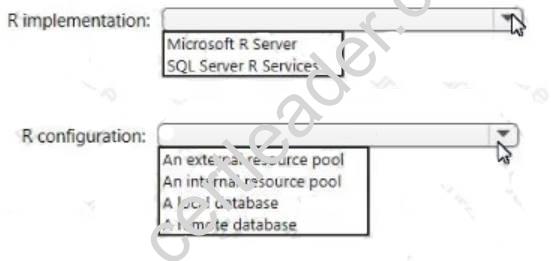
Answer:
Explanation: 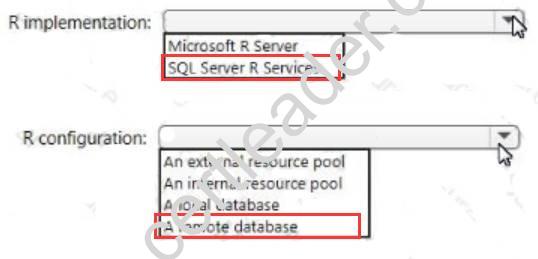
NEW QUESTION 9
You have an Azure Machine Learning environment. You are evaluating whether to use R code or Python.
Which three actions can you perform by using both R code and Python in the Machine Learning environment? Each correct answer presents a complete solution.
NOTE: Each correct selection is worth one point.
- A. Preprocess, cleanse, and group data.
- B. Score a training model.
- C. Create visualizations.
- D. Create an untrained model that can be used with the Train Model module.
- E. Implement feature ranking.
Answer: ABC
NEW QUESTION 10
You are building an Azure Machine Learning experiment.
You need to transform 47 numeric columns into a set of 10 linearly uncorrelated features. Which module should you add to the experiment?
- A. Principal Component Analysis
- B. K-Means Clustering
- C. Normalize Data
- D. Group Data into Bins
Answer: A
NEW QUESTION 11
Note: This question is part of a series of questions that use the same or similar answer choices. An answer choice may be correct for more than one question in the series. Each question is independent of the other questions in this series. Information and details provided in a question apply only to that question.
You need to use only one percent of an Apache Hive data table by conducting random sampling by groups. Which module should you use?
- A. Execute Python Script
- B. Tune Model Hyperparameters
- C. Normalize Data
- D. Select Columns in Dataset
- E. Import Data
- F. Edit Metadata
- G. Clip Values
- H. Clean Missing Data
Answer: A
Explanation: References:
https://docs.microsoft.com/en-us/azure/machine-learning/team-data-science-process/sample-data-hive
NEW QUESTION 12
You have the following HiveQL query in an Import Data module.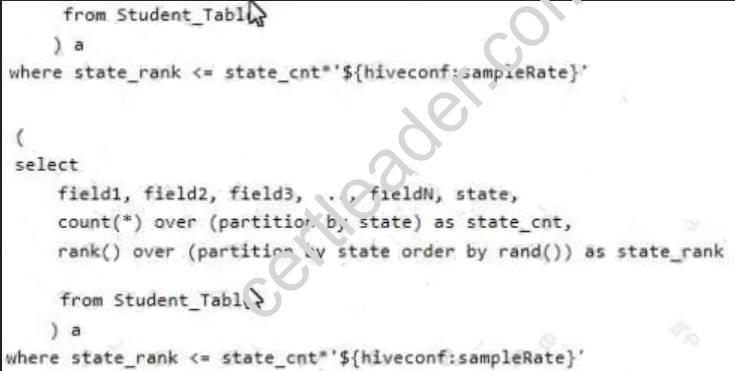
Which type of operation is being performed?
- A. sampling a bucketized table
- B. random sampling by groups
- C. uniform random sampling
- D. stratified sampling
Answer: D
NEW QUESTION 13
You need to create a training set for use with a linear regression model, and then to test the training set.
How should you create the training set? To answer, drag the appropriate modules to the correct locations. Each module may be used once, more than once, or not at all. You may need to drag the split bar between panes or scroll to view content.
NOTE: Each correct selection is worth one point.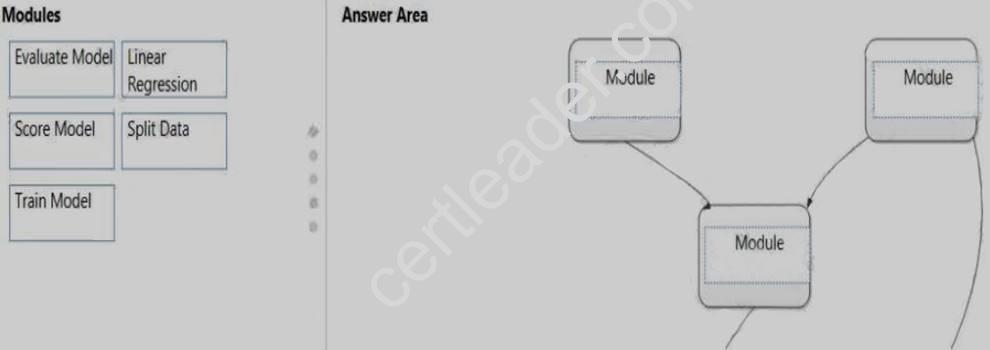
Answer:
Explanation: C:UserswkDesktopmudassarUntitled.jpg
NEW QUESTION 14
You have data about the following:
You need to predict whether a user will like a particular movie. Which Matchbox recommender should you use?
- A. Item Recommendation
- B. Related Items
- C. Rating Prediction
- D. Related Users
Answer: C
Explanation: References:
https://msdn.microsoft.com/en-us/library/azure/dn905970.aspx#RatingPredictionOptions
NEW QUESTION 15
Note: This question is part of a series of questions that use the same or similar answer choices. An answer choice may be correct for more than one question in the series. Each question is independent of the other questions in this series. Information and details provided in a question apply only to that question.
You need to remove rows that have an empty value in a specific column. The solution must use a native module.
Which module should you use?
- A. Execute Python Script
- B. Tune Model Hyperparameters
- C. Normalize Data
- D. Select Columns in Dataset
- E. Import Data
- F. Edit Metadata
- G. Clip Values
- H. Clean Missing Data
Answer: H
Explanation: References:
https://blogs.msdn.microsoft.com/azuredev/2021/05/27/data-cleansing-tools-in-azure-machine-learning/
NEW QUESTION 16
Note: This question is part of a series of questions that present the same scenario. Each question in the series contains a unique solution that might meet the stated goals. Some question sets might have more than one correct solution, while others might not have a correct solution.
After you answer a question in this sections, you will NOT be able to return to it. As a result, these questions will not appear in the review screen.
You are designing an Azure Machine Learning workflow.
You have a dataset that contains two million large digital photographs. You plan to detect the presence of trees in the photographs.
You need to ensure that your model supports the following:
Solution: You create a Machine Learning experiment that implements the Multiclass Decision Jungle module. Does this meet the goal?
- A. Yes
- B. No
Answer: B
Recommend!! Get the Full 70-774 dumps in VCE and PDF From Surepassexam, Welcome to Download: https://www.surepassexam.com/70-774-exam-dumps.html (New 64 Q&As Version)